Board Foot Calculator
Price a whole cut list, not one board — on the quarter system, on nominal 2x4 sizes, or on any thickness you like.
Board feet
4
- Pieces
- 1
- Linear feet
- 8
- Cubic feet
- 0.33
- Cubic metres
- 0.0094
Rough thickness in quarters, random widths. You are billed on the rough size, not on what comes off the planer.
Billed at the rough thickness. Surfaced two sides, a 4/4 board arrives at about 13/16 in — NHLA allows 3/16 in of surfacing up to 1 1/2 in and 1/4 in above it.
Nothing is uploaded and there is no account. The arithmetic runs in this tab.

Built and checked by Branislav Hrivnák, Co-Founder, TechDraw AI. Last checked September 2026.
What the rules here come from
- NHLA, Rules for the Measurement and Inspection of Hardwood and Cypress (2023) — the standard every hardwood tally in North America is taken under.
- Purdue Extension FNR-130, Hardwood Lumber Grades — surface measure, and the rule that an exact half is rounded up one time and down the next.
- USDA Forest Products Laboratory, Wood Handbook, ch. 6 — nominal against dressed softwood sizes under PS-20 (table 6-6).
The arithmetic is covered by 42 assertions that run on every change, including the tally cases below where the plain formula and the invoice disagree. Every figure in the tables on this page is produced by the same code the calculator runs, so the two cannot drift apart.
Trusted by


What is a board foot?
One board foot is 144 cubic inches of wood: a board an inch thick, a foot wide and a foot long. It is a volume, not a shape, so a 1 x 12 x 1 ft, a 2 x 6 x 1 ft and a 1 x 6 x 2 ft board are the same board foot. That is the point. Hardwood comes off the saw in random widths, and you cannot price by the running foot when no two boards in the pile are the same size — so the trade prices the wood by volume and lets the widths fall where they fall.
board feet = thicknessin × widthin × lengthft ÷ 12
or ÷ 144 when the length is in inches too, because that is what 144 cubic inches means. A 4/4 board 6 in wide and 8 ft long: (1 × 6 × 8) ÷ 12 = 4 bd ft.
Where people go wrong is never the division. It is which numbers go into it — and there are three different answers to that depending on which counter you are standing at.
Four boards and their board feet
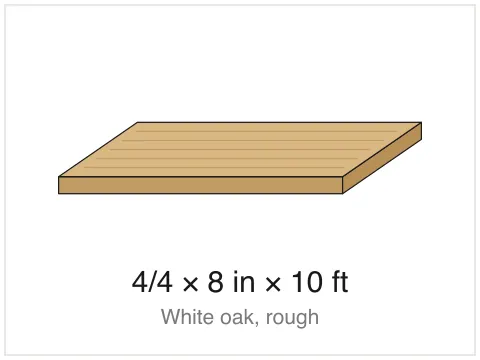
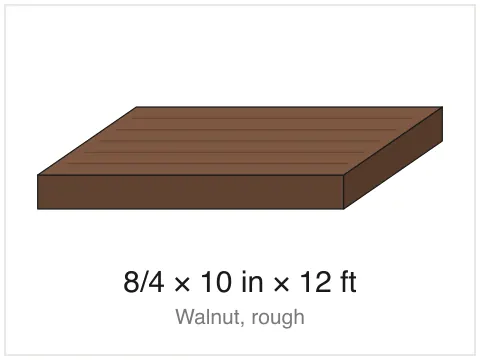
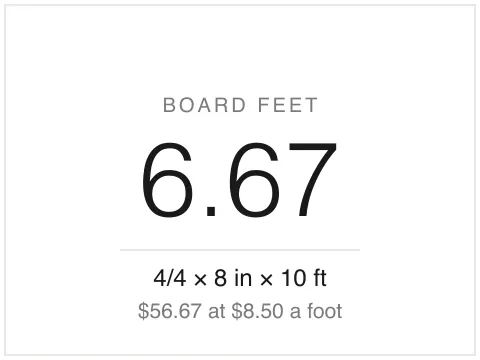
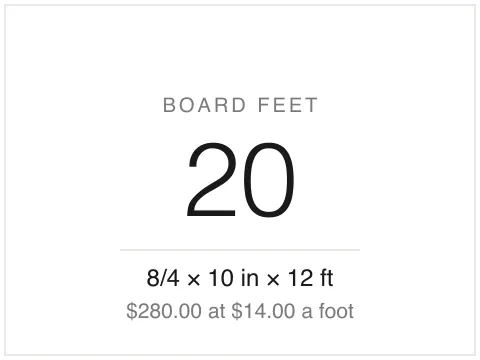
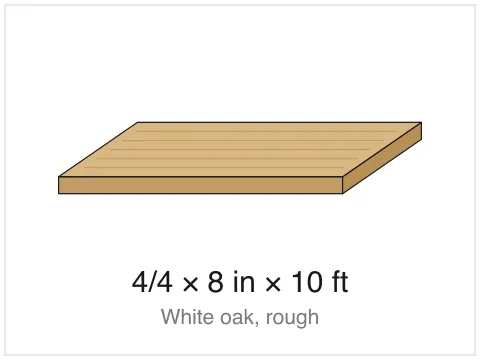
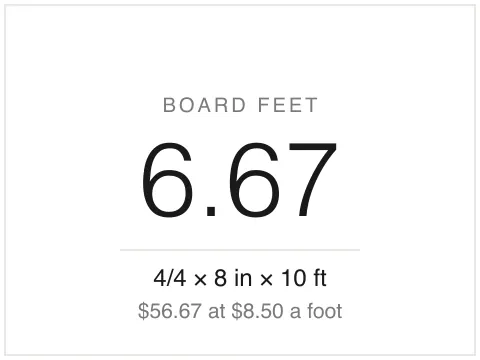
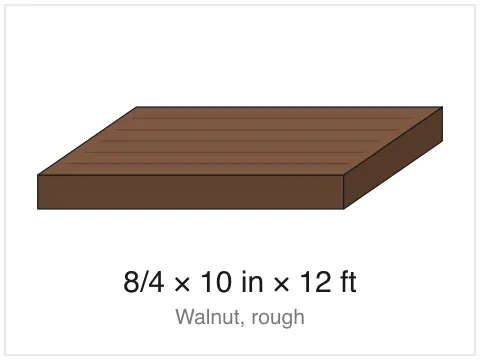
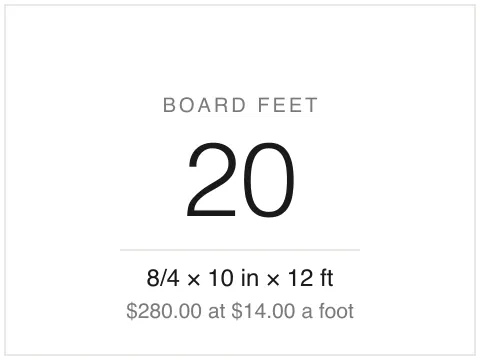
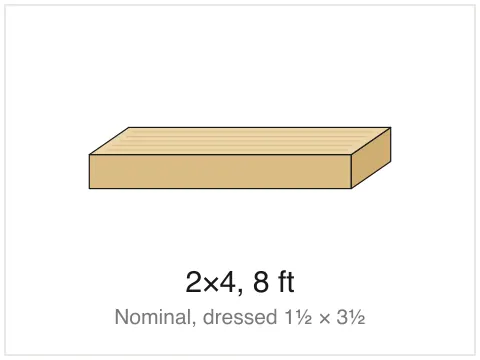
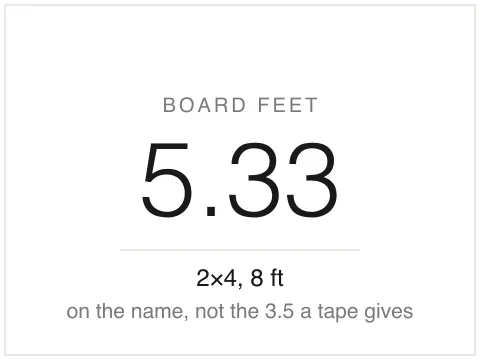
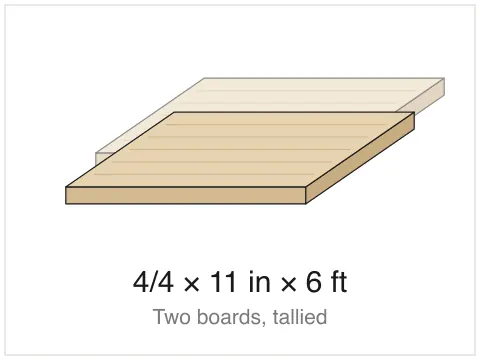
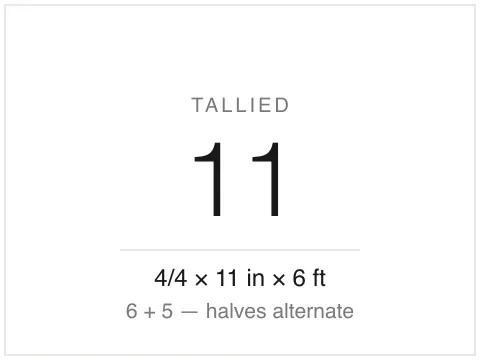
Every figure below is what the calculator above returns for that board — the cards are drawn from the same module the tool runs, so they cannot say something it would not. Thickness and width are to scale between the four; length is compressed to fit the card.
How to calculate board feet
Measure the way the yard sells it
Thickness and width in inches, length in feet. Hardwood: use the rough quarter size (4/4, 8/4), not what the board planes down to. Softwood: use the name on the tag — a 2x4 is figured as 2 by 4 even though it measures 1 1/2 by 3 1/2.
Multiply, then divide by twelve
Board feet = thickness (in) x width (in) x length (ft) / 12. If the length is in inches instead, divide by 144, because one board foot is 144 cubic inches. Multiply by how many boards of that size you need.
Add waste before you buy
Rough lumber comes with wane, checks and a crooked edge, and your cut list never nests perfectly. Ten to fifteen per cent covers straight cuts in clear stock; twenty to thirty is realistic for random-width rough boards or anything with grain matching.
Hardwood: the quarter system, and why you are billed thick
A hardwood yard names thickness in quarter-inches of rough stock. 4/4 is one inch off the saw. It is then dried, which loses thickness, and surfaced, which loses more — NHLA allows 3/16 in up to 1 1/2 in and 1/4 in above that. The board that reaches your bench is thinner than the one on the invoice, and that is the convention rather than a mistake. It is also why you cannot get a full inch of finished 4/4: order 5/4 if you need one.
| Called | Rough (billed) | Surfaced 2 sides | Bd ft, 8 in × 10 ft |
|---|---|---|---|
| 4/4 | 1 in | 13/16 in | 6.67 |
| 5/4 | 1 1/4 in | 1 1/16 in | 8.33 |
| 6/4 | 1 1/2 in | 1 5/16 in | 10 |
| 8/4 | 2 in | 1 3/4 in | 13.33 |
| 10/4 | 2 1/2 in | 2 1/4 in | 16.67 |
| 12/4 | 3 in | 2 3/4 in | 20 |
| 16/4 | 4 in | 3 3/4 in | 26.67 |
Softwood: a 2x4 is a name, not a measurement
Dimensional lumber is named for the size it was before drying and surfacing. PS-20 sets what it actually measures: half an inch off each face up to 7 in nominal, three quarters from 8 in up. Board feet are still figured on the name. Measure an 8 ft 2x4 with a tape and you get 3.5 bd ft; buy it and you are charged for 5.33. Use the name.
| Board | Actually measures | Bd ft (nominal) | If you measured it |
|---|---|---|---|
| 1x4, 8 ft | 3/4 × 3 1/2 in | 2.67 | 1.75 |
| 1x6, 8 ft | 3/4 × 5 1/2 in | 4 | 2.75 |
| 2x4, 8 ft | 1 1/2 × 3 1/2 in | 5.33 | 3.5 |
| 2x4, 10 ft | 1 1/2 × 3 1/2 in | 6.67 | 4.38 |
| 2x6, 8 ft | 1 1/2 × 5 1/2 in | 8 | 5.5 |
| 2x8, 12 ft | 1 1/2 × 7 1/4 in | 16 | 10.88 |
| 2x10, 12 ft | 1 1/2 × 9 1/4 in | 20 | 13.88 |
| 4x4, 8 ft | 3 1/2 × 3 1/2 in | 10.67 | 8.17 |
Why your total and the invoice disagree
A grader does not use the formula. They take the surface measure — the width in inches times the length in whole feet, divided by 12 — round it to the nearest square foot, and multiply by the rough thickness. Three things follow from that, and all three move money.
- Odd inches of length vanish. A board 8 ft 9 in long tallies as 8 ft. Nine inches of oak, gone, on every board in the pack.
- Width rounds to the nearest square foot of surface. A 9 in × 7 ft board is 5.25 sq ft of surface, which tallies as 5. In 8/4 that is 10 bd ft where the formula says 10.5.
- An exact half alternates. An 11 in × 6 ft board is exactly 5.5 sq ft. The rule is to round it up on one piece and down on the next, so the first tallies 6 and the second 5. Over a pack it comes out even, which is why the rule exists; over one board it does not, which is why the price on one board surprises people.
Tick “tally it the way the yard does” in the calculator and it applies all three, piece by piece, carrying the half-rule toggle down the list the way a grader carries it down a pack. We opened the other calculators ranking for this search in September 2026: all of them take one board size at a time and all of them stop at the plain formula. That is the honest reason this page exists.
Board feet in common hardwood sizes
| Board | Board feet | At $8.50 / bd ft |
|---|---|---|
| 4/4 × 6 in × 8 ft | 4 | $34.00 |
| 4/4 × 8 in × 10 ft | 6.67 | $56.67 |
| 4/4 × 10 in × 12 ft | 10 | $85.00 |
| 5/4 × 6 in × 8 ft | 5 | $42.50 |
| 6/4 × 8 in × 10 ft | 10 | $85.00 |
| 8/4 × 8 in × 8 ft | 10.67 | $90.67 |
| 8/4 × 10 in × 12 ft | 20 | $170.00 |
| 12/4 × 6 in × 6 ft | 9 | $76.50 |
The $8.50 is a placeholder to show the shape of a bill, not a quote — hardwood is priced by species, grade and thickness, and 8/4 always costs more per board foot than 4/4. Put your yard's own figure into the calculator.
After the lumber order
A board footage total is the last step of buying and the first step of building. What usually comes next is a cut list that has to be drawn before it can be cut: part sizes, joinery, hardware clearances, a sheet someone in the shop can work from. That is the rest of this site. Photograph a piece of furniture or a sketch and get a dimensioned drawing back, or start from the woodworking side of the tool if you are working from a photo of a joint or a profile.
If you are still choosing how to design the piece, read which free CAD programs suit woodwork before you pay for anything.
Frequently asked questions
What is a board foot?
A unit of volume: 144 cubic inches of lumber, which is a board one inch thick, twelve inches wide and one foot long. It is a volume, so a 1 x 12 x 1 ft, a 2 x 6 x 1 ft and a 1 x 6 x 2 ft board are all one board foot. Hardwood is sold this way because it comes in random widths — you cannot price by the linear foot when no two boards are the same width.
How do you calculate board feet?
Thickness in inches times width in inches times length in feet, divided by 12. A 4/4 board 6 inches wide and 8 feet long is (1 x 6 x 8) / 12 = 4 board feet. If you measured the length in inches, divide by 144 instead: (1 x 6 x 96) / 144 = 4. Multiply by the number of pieces.
Is a 2x4 really 2 by 4?
No. A dry, surfaced 2x4 measures 1 1/2 by 3 1/2 inches — the American Softwood Lumber Standard PS-20 sets the dressed sizes, and the Wood Handbook tabulates them. But board footage for dimensional lumber is figured on the nominal size, so an 8 ft 2x4 is 5.33 board feet, not the 3.5 you get from measuring it. Use the name, not the tape.
What does 4/4 mean, and why am I billed for a thicker board than I got?
4/4 is 'four quarter', meaning four quarter-inches: one inch of rough thickness. 5/4 is 1 1/4, 6/4 is 1 1/2, 8/4 is 2. The yard measures the board rough, before it is surfaced, and that is what goes on the invoice. NHLA allows 3/16 inch of surfacing on stock up to 1 1/2 inches and 1/4 inch above that, which is why surfaced 4/4 arrives at 13/16 inch. You paid for 1 inch and you got 13/16 — that is the trade convention, not a short measure.
Why does my total not match the invoice?
Because a hardwood tally is not the plain formula. The grader takes the surface measure — width in inches times length in whole feet, divided by 12 — rounds it to the nearest square foot, then multiplies by the rough thickness. Odd inches of length are dropped. And when the surface measure lands on an exact half, it is rounded up on one board and down on the next. Tick the tally box in the calculator and it does all three.
How many board feet are in a 4x8 sheet of plywood?
None, in the sense that matters: sheet goods are sold by the sheet or by the square foot, not by board measure. If you need the volume anyway, a 3/4 inch 4x8 sheet is (0.75 x 48 x 8) / 12 = 24 board feet. But no plywood dealer will quote you that way.
What is MBF?
A thousand board feet, the unit lumber is priced in at wholesale — 'M' from the Roman numeral. A quote of $2,400/MBF is $2.40 a board foot. The calculator shows both.
Does this work for logs?
No, and that is deliberate. Scaling a standing tree or a log means estimating how much sawn lumber it will yield, which is a different job done with a log rule — Doyle, Scribner or International 1/4 inch — and the three give different answers for the same log. This page measures sawn lumber, where the volume is a fact rather than an estimate.
Is it free? Do you upload my cut list?
Free, no account, no limit on rows. The arithmetic runs in your browser and nothing leaves the tab, including the CSV — it is built and downloaded on your own machine.