DXF to JPG Converter
Save a DXF as a JPG at the size you need, for a quote, an email or a work instruction.
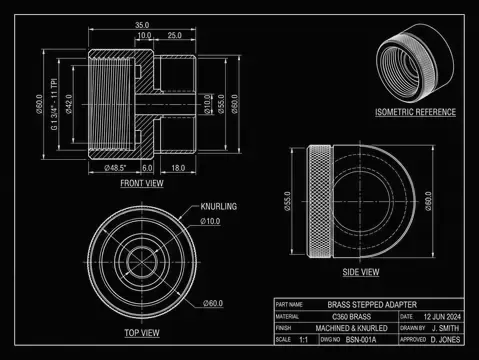
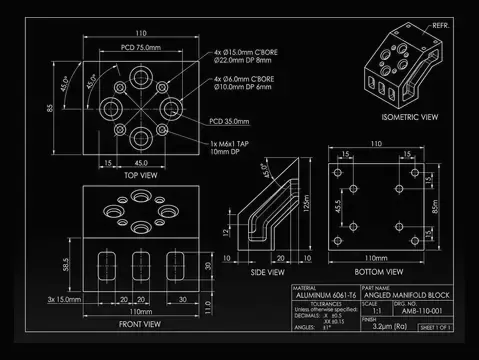
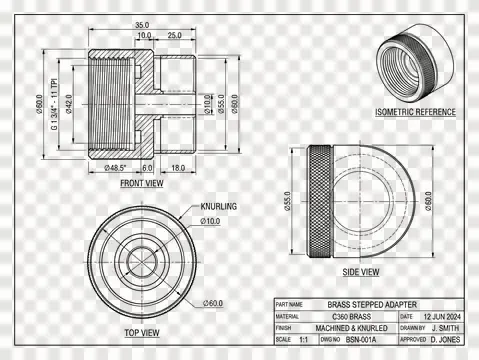
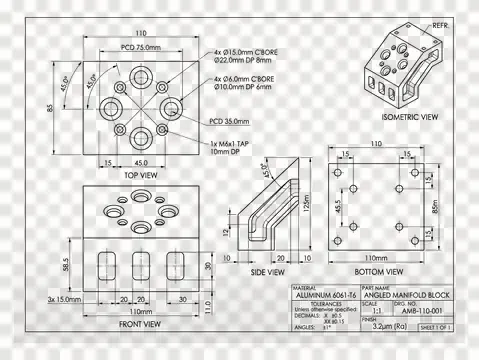
Drop a file here. It never leaves your browser.
DXF (ASCII or binary), DWG (R14 to 2018+), SVG · any size · free · JPG first, DWG, SVG, PDF, PNG, STL one click away
Have a different file? DWG to JPG Converter
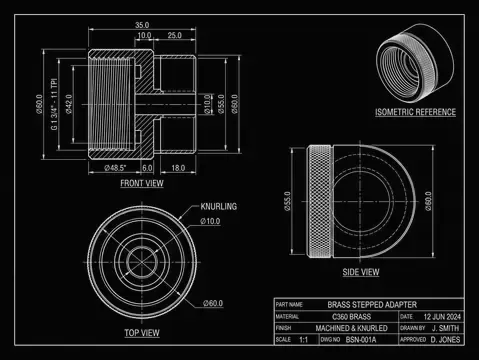
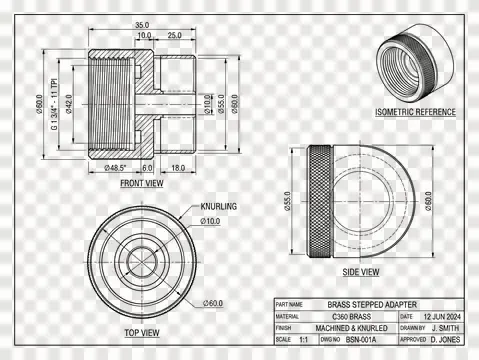
How to convert a DXF to JPG
Add your DXF
Drop a DXF onto the tool, or click to choose one. It is read in your browser and never uploaded.
Check the preview
Zoom the preview and switch off any layers you do not want in the output.
Download JPG
Click Download JPG. DWG, SVG, PDF, PNG, STL are one click away from the same file.
What happens to your file
The DXF is read as geometry and painted onto a bitmap sized from the drawing's own extents, not from the window: you pick an exact pixel width or a true-scale DPI, and the height follows the drawing. Background can be white, dark or, for PNG, transparent; ink can keep the layer colours or go flat black for a report; layers you switch off are left out. What comes back is a picture, so nothing in it can be measured or cut.
Whatever cannot be converted is listed under the preview by type and count, so a drawing with 3D solids or an external reference tells you so instead of coming out quietly incomplete. Need a photo or scan turned into a drawing instead? That is the image to DXF converter and the AI drawing generator.
About formats
DXF (Drawing Exchange Format) is a CAD data file format developed by Autodesk, first released in December 1982 with AutoCAD 1.0 to enable interoperability between AutoCAD and other programs. The format exists in two variants: ASCII DXF, a human readable text file organised into sections (HEADER, TABLES, BLOCKS, ENTITIES, OBJECTS), and binary DXF for faster parsing. Each geometric entity, including lines, arcs, circles, polylines, splines, text, dimensions and 3D solids, is described by group codes paired with values that specify coordinates and properties. DXF versions evolve alongside AutoCAD releases, adding support for new features with each edition. One major advantage is universal CAD compatibility, since DXF is supported by virtually every CAD, CAM and engineering application across all platforms, which makes it the most widely accepted exchange format for technical drawings. The ASCII variant is another strength, because drawings can be inspected, debugged and generated programmatically with text tools or scripts. DXF serves as a critical bridge that lets architects, engineers and manufacturers share precise drawings regardless of which software each party uses, and it remains the standard for cross platform CAD data exchange.
- Developer:
- Autodesk
- Initial release:
- December 1982
Frequently asked questions
Is DXF to JPG conversion free?
Yes, with no watermark and no file limit. Everything runs in your browser, so the file never leaves your computer; a free account is needed only to download a converted file. Viewing needs no account at all.
Is my DXF uploaded anywhere?
No. The file is opened by JavaScript running in your browser tab and never sent to a server. You can disconnect from the internet after the page loads and the tool keeps working. That is the main reason to prefer this over an upload-and-email converter for a drawing you are not allowed to share.
Which DXF files open?
ASCII and binary DXF from R12 to 2018 and later. R12 files with old-style POLYLINE entities are handled, and closed polylines are kept closed, which matters for cutting and for STL.
What resolution will the JPG be?
Whatever you ask for. Two ways to say it: an exact pixel width, where the height follows the drawing's own proportions, or a DPI, where the image is sized so that one inch of the real part becomes that many pixels. The DPI mode is the useful one if the picture has to be printed, because at 300 dpi printed at 100 % it comes out the size of the part. The page shows the exact pixel size before you download.
Can I get a JPG with a transparent background?
No, and that is the format rather than the tool: JPEG has no alpha channel. Asking for it here gives you white instead, and the page says so. Use the PNG page if you need transparency.
Why does my drawing look wrong in colour?
Because most DXF and DWG files are drawn for a black screen, so the layers are bright cyan, yellow and white, which are close to invisible on white paper. Leave the ink on the drawing's own colours and anything too pale is darkened automatically; switch it to flat black and every layer comes out black, which is what a report or a work instruction usually wants.
Can I measure something on the JPG?
No, and nothing can. A raster holds pixels, not geometry: there are no layers, no units and no coordinates, so nothing in the image can be measured, snapped to or cut. Keep the DXF or DWG as the master and treat the image as a picture of it. If you need something that stays measurable, export SVG or PDF instead.
How big can the image be?
Up to 16,384 pixels on a side and about 40 megapixels in total, which is where browsers stop allocating a canvas. Ask for more, by setting a high DPI on a large site plan for instance, and the size is reduced to fit rather than handing back a blank file, and the page tells you it was reduced.
What is not converted?
3D solids, surfaces, meshes and regions (ACIS data), raster images, PDF underlays, OLE objects, external references, and paper-space layouts. Tables, multileaders and tolerances are read but not drawn. Whatever was skipped is listed under the preview after the file opens, by entity type and count, so nothing disappears silently.
I have a DWG or SVG instead. Can I still use this?
Yes. The converter on every one of these pages accepts DXF, DWG and SVG, whichever page you started from, and offers every output it can produce from that file.
Is there an API for DXF to JPG?
Not for this tool yet. The converter runs entirely client-side. The REST API, command line tool and MCP server currently cover image to DXF, DWG and STL; if you need vector conversion in a pipeline, say so at the contact page and it moves up the list.