
ChatGPT will not bend your part, and any prompt that hands you a tonnage figure to load straight into the brake is going to crack a flange or overload a machine. What it is genuinely good at is the work either side of the press: reading an unfamiliar print, roughing out a quote, working through bend allowance step by step, thinking about weld sequence, decoding a hardware callout, and telling you why a bend came out short. Used that way it is an apprentice that has read every design guide. Below are 20 prompts written for the person on the shop floor, grouped by the job they do, each ready to copy, paste and fill in.
Our articles are still written by humans!
Get human written articles in your Google feed.
How to use these prompts
A prompt is only as good as the setup you hand it. Four habits make every one of these work harder:
- Give it a role and a shop.“Act as an experienced sheet metal fabricator working on a 100 tonne CNC press brake” sets the register far better than a cold question.
- Name the material and thickness every time. Replace every
[MATERIAL]and[THICKNESS]with the real spec. 1.5 mm 304 stainless and 3 mm mild steel behave nothing alike, and a vague prompt gets you an answer that fits neither. - Ask one thing at a time. Flat pattern first, then tooling, then tonnage. Bundling the whole job into one prompt gets you a shallow answer to each piece of it.
- Verify before you cut. Cross-check every number against your tooling data and your own judgement. The chatbot has never touched your machine.
Read the print and the flat (1 to 4)
1. Turn a drawing into a fabrication checklist
Gets the whole job onto one list before anything is cut.
Act as an experienced sheet metal fabricator. I'll attach (or describe) a part drawing: [DESCRIBE PART / PASTE DIMENSIONS, MATERIAL, THICKNESS, NOTES]. Turn it into a fabrication checklist: every cut feature, every bend with its angle and direction, all hardware and weld requirements, the finish, and the tightest-tolerance features I must not miss. Flag anything ambiguous I should query before I book material.
2. Decode the callouts on a fab drawing
Clears up the shorthand without leaving the machine.
Explain these sheet metal callouts and symbols in plain fabricator terms, and tell me what each one means for how I cut, form or finish the part: [LIST, e.g. 16 GA, 1.5 THK, R1.5 INSIDE, HEM, EMBOSS, X4 PEM CLS-632-2, the weld symbol 6 fillet 50-100, Ra 1.6, ISO 2768-m]. Note any that mean something different under ISO vs ASME, and any that change my material buy.
3. Find the missing information before you cut
Surfaces the questions a good fabricator asks first.
Review this part for anything a fab shop would have to clarify before cutting: missing material or gauge, no inside bend radius specified, bend direction not shown, no grain direction where it matters, hardware with no part number, untoleranced critical dimensions, no finish spec. List each gap as a specific question I would send back to the customer. Details: [PASTE notes/dimensions or attach the drawing].
4. Work the flat pattern out of a formed part
The calculation, bend by bend, so you can check your CAD.
I have a formed part in [MATERIAL] at [THICKNESS] mm with an inside bend radius of [RADIUS] mm. The formed dimensions are: [LIST EACH LEG / FLANGE LENGTH AND EACH BEND ANGLE]. Using a K-factor of [K, or say "assume 0.44 and tell me how sensitive the result is"], work out the bend allowance for each bend and the total developed flat length. Show each step so I can check it against my CAD flat.
 Photo
Photo Drawing
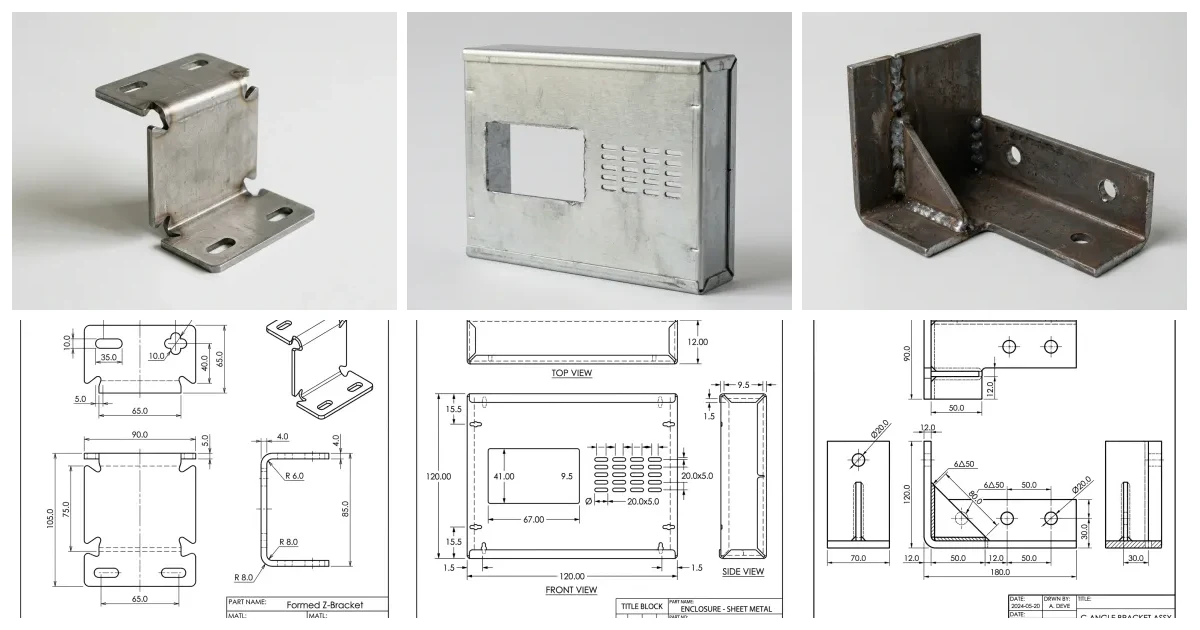
That last point is worth sitting with. Prompts 1 to 4 all assume you have a drawing. Plenty of jobs arrive as a bare part in a bag, and no chatbot can measure it for you. That is a different tool: our AI technical drawing generator rebuilds the dimensioned views from a photograph and one measurement you take, and sheet metal drawings from a photo walks through the fab specific version of it.
Quote, nest and buy material (5 to 8)
5. Break a job into operations and estimate the time
The structure of a quote, before you put money against it.
Act as an estimator in a sheet metal shop. For this part, list every operation in order (laser or punch, deburr, form, tap or insert hardware, weld, dress, finish, assemble, pack), and give a realistic setup time and run time per piece for a batch of [QTY]. Part: [MATERIAL, THICKNESS, SIZE, NUMBER OF BENDS, HARDWARE, WELDS, FINISH]. State the assumptions behind each time so I can correct them with my own rates.
6. Pressure-test a quote you have already written
A second pair of eyes on the number before it goes out.
Here is my quote breakdown for a sheet metal job: [PASTE OPERATIONS, TIMES, RATES, MATERIAL COST, QTY, MARGIN]. Act as a sceptical shop owner and challenge it. Which operations have I underestimated, what have I forgotten to charge for (setup, programming, tooling changes, secondary ops, freight, packaging, scrap allowance), and where is the biggest risk if the batch runs badly?
7. Improve material utilisation on a nest
Turns offcut into margin.
I am nesting [QTY] of a part with a bounding box of [X] x [Y] mm on [SHEET SIZE] sheets of [MATERIAL] at [THICKNESS] mm. Suggest ways to improve utilisation: part rotation and mirroring, common line cutting where it is safe, sensible part to part and part to edge gaps for this thickness, and where to nest small parts inside larger cut-outs. Tell me what utilisation percentage is realistic here and what would be optimistic.
8. Translate gauge, grade and equivalents
Stops the wrong sheet arriving on the truck.
Convert and cross-check this material spec for me: [e.g. 14 GA mild steel, or 1.5 mm 304 2B, or 5052-H32 0.080 in]. Give the thickness in both mm and inches, the nearest common gauge, the closest equivalent grades in EN and ASTM, and note anything about this grade that changes how it forms or welds compared with the obvious substitute. Flag if the tolerance on sheet thickness could affect my bend results.
Bend allowance and forming (9 to 12)
9. Derive your own K-factor from a test bend
The one number that makes every later calculation yours.
I bent a test coupon to check my K-factor. Material [MATERIAL] at [THICKNESS] mm, inside radius [RADIUS] mm, bend angle [ANGLE] degrees. Flat blank length before bending: [FLAT] mm. Measured leg lengths after bending: [LEG A] and [LEG B] mm. Work backwards to the actual bend allowance and the K-factor for this combination, show the working, and tell me how much my flat length changes if the K-factor is out by 0.05.
10. Check flange, relief and hole clearances
The three rules that cause most reworked parts.
Check this part against standard sheet metal forming rules and tell me what will not form cleanly: [MATERIAL, THICKNESS, INSIDE RADIUS, LIST FLANGE LENGTHS, DISTANCES FROM HOLES AND SLOTS TO THE NEAREST BEND, ANY BENDS THAT MEET AT A CORNER]. For each problem give the rule of thumb, the minimum value it should be for my thickness, and the cheapest fix (lengthen the flange, add bend relief, move the hole, or pierce it after forming).
11. Pick the die and estimate tonnage
A starting point to check against your own tooling chart.
For an air bend in [MATERIAL] at [THICKNESS] mm, bend length [LENGTH] mm, target inside radius [RADIUS] mm: recommend a sensible V-die opening, the inside radius that die will actually produce, the minimum flange length that die allows, and the approximate tonnage per metre and total. Show the formula and the tensile strength value you assumed. Tell me what changes if I use the next die size up or down.
12. Plan the bend sequence
Stops the part colliding with the machine on the last hit.
Work out a bend sequence for this part so nothing collides with the tooling or the back gauge and every bend still has a usable reference edge: [DESCRIBE THE PART AND EACH BEND: position, angle, direction (up or down), flange length]. Give the order, say which edge to gauge from at each step, and flag any bend that will be hard or impossible to reach once an earlier bend is formed.
Welding, hardware and finish (13 to 16)
13. Control distortion on a welded assembly
Cheaper than straightening it afterwards.
I am welding this sheet metal assembly: [MATERIAL, THICKNESS, JOINT TYPES, WELD LENGTHS, OVERALL SIZE, FLATNESS REQUIREMENT]. Recommend a process and a welding sequence that minimises distortion: where to tack and in what order, whether to stitch or run continuous, how to balance welds about the neutral axis, and what fixturing or clamping to use. Tell me what distortion I should still expect and how to correct it.
14. Read or write a weld symbol
Removes the ambiguity that gets welded in.
Explain exactly what this weld symbol specifies, in plain terms, including which side of the joint the weld goes on: [DESCRIBE THE SYMBOL, e.g. fillet, 6 mm leg, 50 mm long at 100 mm pitch, arrow side, field weld flag, weld all round]. Then write the correct AWS symbol for what I actually want, which is: [DESCRIBE IN WORDS]. Note anything that would change under ISO 2553.
15. Choose and place self-clinching hardware
The clearances that decide whether an insert holds.
I need to install self-clinching [nuts / studs / standoffs] in [MATERIAL] at [THICKNESS] mm for an [M] thread. Recommend a suitable fastener type, the required hole diameter, the minimum distance from the hole centre to a sheet edge and to a bend, which side of the sheet to install from, and the sheet hardness limit for this fastener. Tell me what goes wrong if I install after forming instead of before.
16. Write a finishing specification
So the coater and the customer read the same thing.
Write a clear finishing specification for this part: [MATERIAL, THICKNESS, END USE, ENVIRONMENT, COSMETIC OR NOT]. Cover deburring, edge condition, any graining direction, pre-treatment, the coating system and colour reference, thickness of coating, which surfaces and threads must be masked, and how it should be inspected and packed. Keep it to a block I can put on the drawing.
 Photo
Photo Drawing
DFM and troubleshooting (17 to 20)
17. Run a DFM review before you quote
The prompt that saves the most money, used earliest.
Act as a sheet metal DFM reviewer. Go through this part and list everything that will make it more expensive or less repeatable to fabricate, with a cheaper alternative for each: [MATERIAL, THICKNESS, DESCRIBE FEATURES, TOLERANCES, HARDWARE, FINISH, QTY]. Cover unnecessarily tight tolerances, mixed bend radii, features too close to bends, small holes relative to thickness, hand-work the design forces, and anything that stops the part nesting well.
18. Diagnose a bend that came out the wrong length
Turns a scrapped part into a corrected flat.
My formed part is coming out [X] mm too [long / short] across [WHICH DIMENSION]. Material [MATERIAL] at [THICKNESS] mm, inside radius [RADIUS], [NUMBER] bends at [ANGLES], K-factor assumed [K], V-die [SIZE]. Work through the likely causes in order of probability, tell me how to confirm each one, and give me the corrected flat length. Include how much of the error each cause would typically account for.
19. Diagnose cracking or marking on a bend
Separates a material problem from a tooling one.
I am getting [cracking on the outside of the bend / die marks on the surface / an inconsistent angle along the bend] in [MATERIAL] at [THICKNESS] mm, inside radius [RADIUS], V-die [SIZE], grain running [along / across] the bend line. Diagnose the likely cause, tell me which of grain direction, bend radius, die opening, tooling condition or material temper is most likely responsible here, and give the fixes in order of how cheap they are to try.
20. Write the shop-ready general notes block
The block that stops half the questions before they are asked.
Write a concise, shop-ready general notes block for a formed sheet metal part in [MATERIAL] at [THICKNESS] mm. Cover: default general tolerance and the standard it refers to, inside bend radius unless stated, break all sharp edges and deburr, grain direction if it matters, hardware installation before or after finish, coating and masking, and the inspection requirement. Keep it under eight numbered lines.
Where ChatGPT stops on the shop floor
Be clear about the line, because the failures in this trade are expensive and they are physical. ChatGPT has never touched your brake. It does not know that your 100 tonne machine has a tired crowning system, that the 12 mm die is the one with the chipped shoulder, or that the last coil of 1.5 mm you took in runs a little thin. Every number it gives you is the textbook answer to the question you typed, which is a genuinely useful thing and is not the same as an answer about your shop.
Three specific limits worth naming. It cannot produce geometry, so no prompt gets you a cut-ready DXF, only the arithmetic behind one. It cannot see your part unless you photograph it, and even then it reads a picture rather than measuring an object. And it is confidently wrong in exactly the places that cost most, tonnage and tolerance, because those answers look identical whether the inputs were right or not. The same honest boundary applies to drawings themselves, which we tested in can ChatGPT make technical drawings.
Used inside that boundary it is a genuinely good addition to the shop. The neighbouring guides cover the other side of the same work: ChatGPT prompts for CNC machinists for the milling and turning side, ChatGPT prompts for technical drawing for the drafting itself, and preparing a DXF for laser cutting for the file that actually reaches the machine. If the job started as a part rather than a print, AI technical drawings for sheet metal is where that gap gets closed.
Frequently asked questions
Can ChatGPT calculate bend allowance?
It can do the arithmetic correctly if you give it the inputs: material thickness, inside bend radius, bend angle and a K-factor. What it cannot do is know your K-factor, because that depends on your material, your press brake, your tooling and how your machine has worn. Treat any number it returns as the formula worked out for you, not as a value to program. Measure one test bend on your own brake and feed that back in.
Can ChatGPT read a sheet metal drawing?
With image input it reads a drawing and summarises views, dimensions, tolerances, hole sizes, hardware callouts and notes, which is a quick way to check you have not missed something on an unfamiliar print. It misreads small stacked dimensions, faint weld symbols and anything handwritten, so verify anything that drives a cut, a bend or a price against the original.
Is it safe to use ChatGPT for press brake tonnage?
Only as a first estimate. The standard tonnage formula needs material tensile strength, thickness, V-die opening and bend length, and ChatGPT will apply it correctly. It has no idea of your machine's rating, your tooling condition, or whether the die you actually have fits the job. Always cross-check against your tooling supplier's tonnage chart and your machine's limit before you load a part.
Can ChatGPT create a flat pattern for me?
It can walk you through the calculation and give you the developed length for simple parts, bend by bend. It cannot produce a cut-ready flat pattern file, because that needs real geometry rather than text. For a DXF you can put on the laser, you need CAD or a tool that outputs actual geometry from the part or a photo of it.
What is the best ChatGPT prompt for a fabricator?
There is no single best one. The results improve sharply when you give it a role such as an experienced sheet metal fabricator, name the material, thickness and process, and ask one question at a time. In practice the DFM review, the bend allowance and the quoting prompts in this guide earn their keep fastest, because they catch problems before material is cut.
Sources
- FMA: The Fabricator, press brake bending and bend allowance fundamentals
- Xometry: Sheet metal design guide, bends, reliefs and hole spacing
- PennEngineering: PEM self-clinching fastener installation data
- ISO 2768: General tolerances for linear and angular dimensions
- AWS A2.4: Standard symbols for welding, brazing and non-destructive examination